We partner with automotive manufacturers to integrate vital signs monitoring directly into vehicle dashboards. Heart rate, blood pressure, blood oxygen, and alcohol detection — seamlessly displayed on existing screens. No extra hardware. Maximum safety.
A universal safety standard built to be embedded in every vehicle that leaves the factory floor — cars, trucks, buses, trains, planes, boats, and heavy machinery.
Today's "smart" cars don't know if you've taken your blood-pressure medication, if your oxygen is dropping, or if you're seconds from a cardiac event. By the time a human realizes something's wrong, the wheel is already turning toward oncoming traffic.
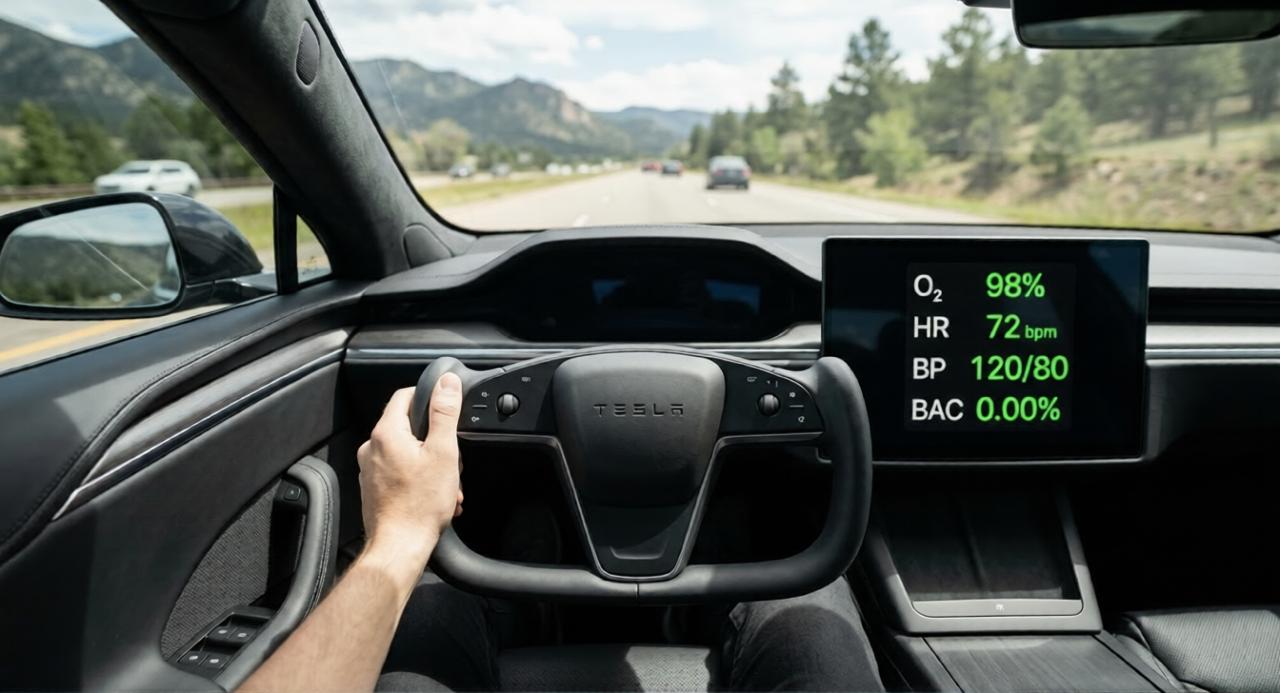
Vital signs displayed as compact metrics on your existing infotainment system. No additional screens, no bulk, no extra cost to consumers.
Steering-wheel electrodes + firmware = $50–80 per unit at scale. Dramatically lower than competing health-tech. High margin for OEMs.
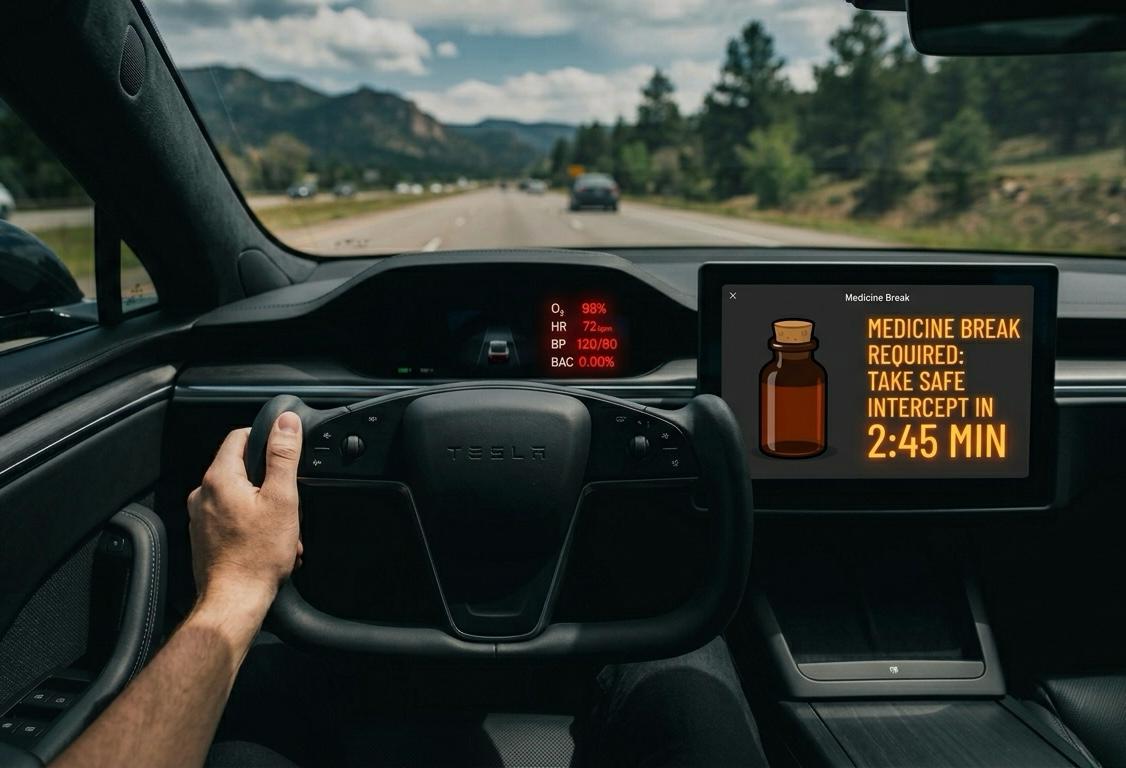
The smart pill bottle integration activates exclusively when real-time vitals cross a dangerous threshold — elevated heart rate, plummeting SpO₂, or other critical biometric signals. It is not a scheduled reminder. It never prompts a driver to take medication on a timetable. It fires only when the body says it must.
OEMs reduce accident liability by 60%. Insurers offer fleet discounts, making your vehicles more competitive in commercial markets.
Connects via standard vehicle CAN-FD network. Works with any modern vehicle. Easy to retrofit. Minimal engineering overhead for OEM partners.
Engineered for every vehicle category: cars, trucks, buses, trains, aircraft, marine vessels, and heavy machinery. One platform, one integration pathway — scalable across an entire manufacturer's product lineup.
Six layers of real-time intelligence over standard CAN bus and the vehicle's existing dashboard. Zero new screens. Zero consumer-facing hardware.
Capacitive electrodes in the steering wheel detect heart rate, blood oxygen, and ECG signals. Bioimpedance sensors measure blood pressure. Data updates every 500 ms continuously while driving.
Vital signs appear as compact metrics on the existing vehicle dashboard (top corner or HUD): Heart Rate, Blood Oxygen, Blood Pressure, Alcohol Level. Driver always knows their status.
AI algorithms process vitals and compare against the driver's baseline. The system learns normal patterns and detects dangerous anomalies in real time using medical-grade filtering.
When biometric readings cross a critical threshold — not on a schedule, but purely in response to the driver's live vitals — a medicine-bottle alert appears on the dashboard. This is a reactive emergency trigger, not a reminder system. The vehicle guides the driver to a safe stop.
At a complete stop (brake applied > 2 seconds), the system rechecks vitals. If recovered → alert clears, driver continues safely. If not → escalates to the emergency protocol.
If vitals remain critical: the vehicle gradually disables (steering reduction), hazards activate, emergency services receive GPS coordinates, and contacts are notified with full vital-sign history.
Incumbent DMS (Driver Monitoring Systems) solve lane-keeping and attention. Vital'Go2.0 solves the problem that precedes attention — an operator who is medically incapacitated before showing any visual cue. And unlike camera-based DMS, our steering-wheel-native sensor stack works in any vehicle: cars, trucks, buses, trains, planes, boats, and heavy machinery.
Watch the IoT-enabled steering system detect a critical event and guide the vehicle to a safe stop.
Vitals stream silently to the side HUD. The driver feels nothing — just the leather of the wheel.
The medicine-bottle alert appears on the existing infotainment screen exclusively when live biometric readings cross a dangerous threshold. It is a reactive emergency trigger — not a scheduled medication reminder. The countdown guides the driver to a safe stop; if vitals do not recover, hazards engage and LTE-M transmits GPS and vital history to emergency services.
Real reference mockups of Vital'Go2.0 vitals on a production dashboard, the medicine-bottle critical alert, and the underlying steering-wheel + CAN-bus electronics that make it possible — all displayed on hardware OEMs already ship.
O₂, HR, BP, BAC shown in the corner of the existing infotainment screen.
Alert fires only when live vitals cross a dangerous threshold — never on a timed medication schedule.
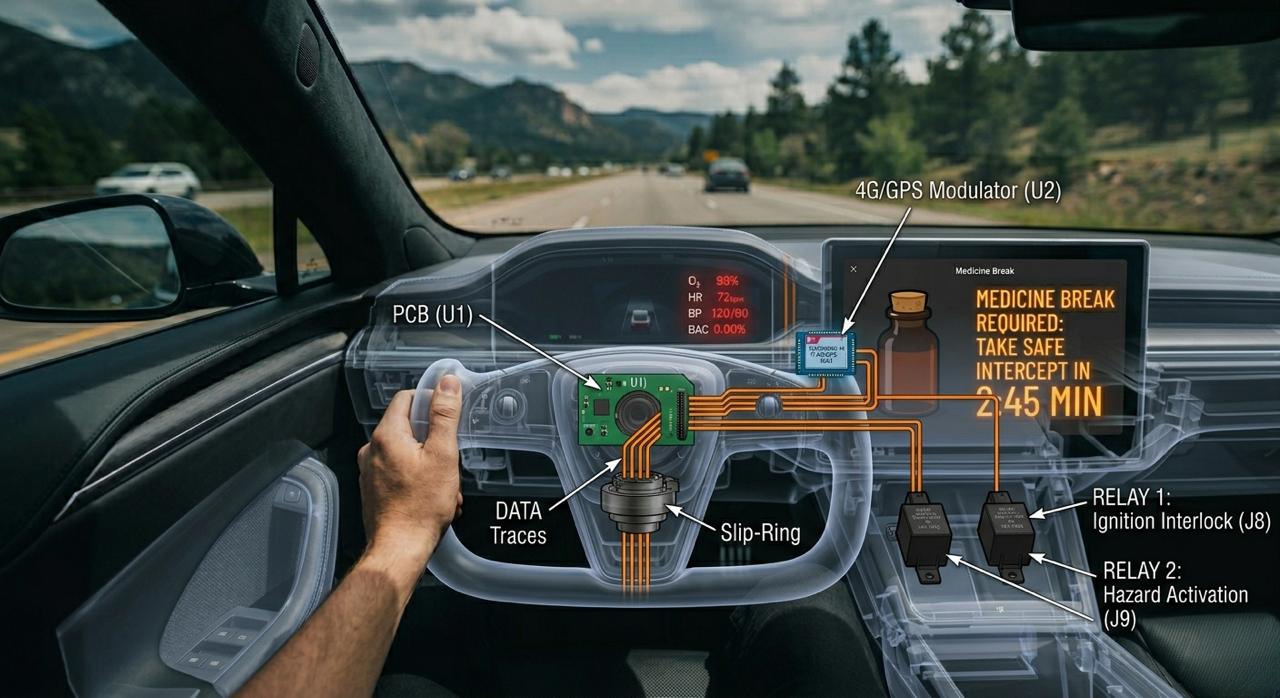
PCB (U1), slip-ring, 4G/GPS modulator (U2), ignition interlock + hazard relays — wired over standard CAN.
Every component was selected for automotive temperature ranges, vibration tolerance, and redundancy. The full stack runs on under 2.8W — cool enough to live behind the airbag for a decade.
We document our hardware because integrators trust what they can audit. Below is the actual mapping from the production board — ESP32-S3 pins 13/14 for native USB, and pins 38/39 routed through the LSF0204 level shifter to the SIM7080's 1.8V UART.
| Pin | Role | Note |
|---|---|---|
| GPIO 13 | USB D- | Native USB-OTG (CDC) firmware + serial |
| GPIO 14 | USB D+ | Native USB-OTG (CDC) firmware + serial |
| GPIO 38 | UART2 TX → LSF0204 A1 | 3.3V → 1.8V to SIM7080 RX |
| GPIO 39 | UART2 RX ← LSF0204 A2 | 1.8V → 3.3V from SIM7080 TX |
| GPIO 4 | SIM_PWRKEY | Open-drain, 1.2s pulse to boot modem |
| GPIO 5 | SIM_STATUS | Modem-ready indicator |
| GPIO 17 | RELAY_1 · Ignition | Active-LOW, opto-isolated |
| GPIO 18 | RELAY_2 · Hazards | PWM 2.4 Hz high-frequency flasher |
| GPIO 8 / 9 | I²C bus | MAX30102 + MiCS-5524 ADC @ 400 kHz |
| GPIO 19 / 20 | DCMI · OV2640 | QVGA @ 30 fps for iris tracking |
Flexible licensing structures designed for any vehicle manufacturer — automotive, marine, aerospace, rail, and heavy industry — all built around recurring revenue.
Vital'Go2.0 hardware and firmware licensed per vehicle at production. OEM owns the wheel; we supply the sensor stack, firmware, and cloud API.
Monthly subscription per vehicle for real-time vitals monitoring, incident logs, compliance reporting, and emergency dispatch integration — across any vehicle category.
Direct-to-consumer and dealer channel: a compatible steering wheel with full sensor suite for existing vehicles, sold with 1-year SaaS included.
The partner receives exclusive first-mover integration rights for their vehicle segment, co-development input on the next hardware revision, and a favourable volume licensing rate locked for 3 years.
Unified Innovations of Alabama is a mechatronics engineering team with hands-on experience in embedded systems, IoT connectivity, and automotive hardware design.
ESP32-S3 architecture, automotive-grade PCB design, sensor fusion, and LTE-M integration.
LTE-M protocol stack, real-time telemetry pipelines, and fleet dashboard backend.
MAX30102 signal conditioning, SpO₂ algorithms, drowsiness inference model training.
For partnership enquiries, technical due diligence, or integration feasibility discussions, contact our team directly. We respond to all serious manufacturer and integration inquiries within one business day.
Unified Innovations of Alabama · For press, pilots, research and integrator inquiries.
